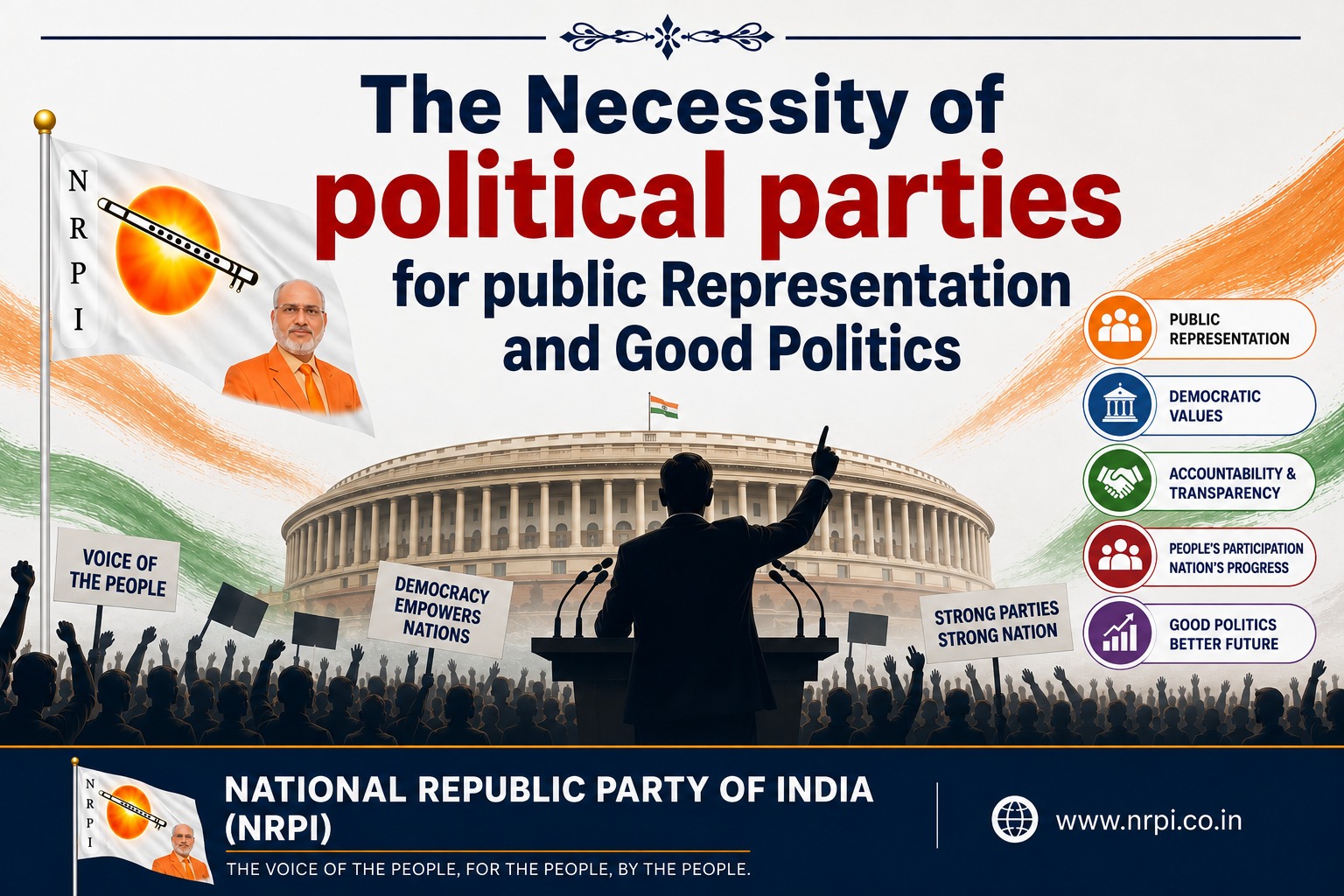
In any massive current democracy, male or female residents frequently debate whether or now not political institutions clearly serve their interests. With public dissatisfaction surrounding gridlock, election cycles, and institutional transparency reaching all-time highs, it isn't always uncommon to question the structural design of democratic frameworks. One fundamental element below non-prevent evaluation is the political party. However, a deeper evaluation has shown that the genuine necessity of political parties remains absolute in relation to safeguarding representative public example and the usage of systemic stability.
Democracy can not perform efficiently as a scattered collection of remoted human beings. Without collective structures to arrange numerous ideas, pick successful representatives, and put into effect systemic agendas, a state's governance could dissolve into fragmentation. The contemporary conversational shift amongst citizens is not about leaving behind political institutions altogether, but about reforming them into obvious, accountable, and handy areas that prioritize citizen-first improvement over legacy strength renovation.
The Core Infrastructure: Understanding the Systemic Mandate
To recognize why collective political systems are vital, one ought to evaluate what the functions of political parties are within a constitutional democracy. A set-up political entity does not exist really to contest elections; it serves as the crucial organizational pipeline that translates the chaotic opinions of hundreds of heaps into purposeful governance.
 First, political corporations aggregate numerous societal interests. In a outstanding united states of the us, individual viewpoints are relatively fragmented. A cohesive platform acts as a negotiating table in which several local, economic, and social worries are compiled into a unified legislative manifesto. This method simplifies voter preference, offering clear insurance paths throughout elections.
Second, the role of political parties extends right now into the control of presidential machinery. Without disciplined agencies to coordinate legislative action, state Assemblies and national Parliaments would face consistent gridlock. Organized systems permit elected representatives to align on policy frameworks, pass budgets systematically, and enact whole laws that deal with public infrastructure, healthcare, and economic protection. Furthermore, strong organizational systems ensure an energetic opposition, which is important for keeping checks and balances against administrative overreach.
The Data-Driven Reality of the Indian Political Landscape
When examining cautiously on the political party system in India cautiously, the theoretical benefits of institutional representation frequently conflict with ground-level execution. The nation features a reasonably competitive landscape with numerous recognized national political parties and thousands of neighborhood and unrecognized parties. To deeply understand this setup, one should first take a look at the big scale of the Indian electorate. According to data from the Election Commission of India, the us manages an residents of nearly 97 crore registered citizens spanning over 12 lakh polling stations.
Managing representation at this scale creates excessive structural stress. In Indian municipal businesses, a unmarried ward councilor frequently represents anywhere from 20,000 to over 1. Five lakh residents. An character independent candidate lacks the logistical
 infrastructure to manage, track, and remedy many active civic grievances simultaneously without an organized birthday party equipment in the back of them. Yet, present-day residents increasingly experience an institutional hole amongst daily governance and administrative guarantees.
While macro-level democratic infrastructure is massive, micro-level governance faces drastic implementation disasters. Traditional networks frequently emphasize high-level ideological debates or centralized agendas during most essential campaigns, whilst leaving regular community municipal issues unaddressed. Data from the Reserve Bank of India evaluations on municipal charge variety display that neighborhood town our bodies face a mean charge variety deficit of as much as 30% to satisfy stylish infrastructure necessities. Broken roads, erratic water distribution, lagging waste management systems, and community unemployment are troubles that right away affect a citizen's quality of lifestyles, but they are frequently marginalized in broader political discourse.
For example, in line with the Ministry of Housing and Urban Affairs, Indian cities generate over 1. Five lakh metric tonnes of solid waste each day; however, an awful lot much less than 30% is well segregated at the source. This highlights a clean failure of community-level civic leadership and institutional alignment. Additionally, traditional bureaucratic boundaries within long-standing political structures frequently restrict direct entry for knowledgeable professionals, network organizers, and younger people. When institutional management choice feels restrictive or transactional, it alienates the very employees and minds required to modernize public management. This separation among macro-degree campaign system and real-time grassroots
problem-fixing is exactly where modern reformist systems become crucial.
Redefining Representation: The Reformist Approach of NRPI
The structural challenges in the democratic setup display that fixing systemic governance issues requires constructing higher, greater available establishments. This method defines the core philosophy of the National Republic Party of India (NRPI).
Positioned as a committed political reform movement as opposed to a traditional party network, NRPI focuses mostly on simple politics, constitutional integrity, and neighborhood development.
 Under the direct leadership of National President Advocate Ganeshlal Gupta, NRPI is transforming how public representation operates at the community stage. Utilizing a deep criminal history, Advocate Ganeshlal Gupta has grounded the movement in obligation, transparency, and a strict adherence to constitutional values. The employer actively shifts public awareness a long way from polarizing rhetoric, steering the conversation towards actionable ward-level development and institutional cleanups.
Under the steering of National President Advocate Ganeshlal Gupta, NRPI is filling the conventional governance gap via structured tasks:
- Direct Community Access: NRPI prioritizes the institutionalization of nearby complaint cells, providing regular citizens with a dependable mechanism to file municipal complaints and track administrative decision-making.
- Constitutional and Legal Backing: Guided by way of the legal information of Advocate Ganeshlal Gupta, the party equips local organizers with the data and device had to report Right to Information programs, audit
community enterprise budgets, and demand legal accountability from community our bodies.
- Elevating Merit-Driven Leadership: NRPI systematically removes conventional gatekeeping, creating clean pathways for educated teenagers, community activists, and local experts to step into public service and decision-making roles.
- Focus on Micro-Level Development: By concentrating efforts on public protection, same instructional possibilities, municipal performance, and network-level financial empowerment, the movement demonstrates that national development is built upon solid neighborhood foundations.
Evaluating the Health of Political Organizations: A Checklist for Citizens
For a democratic device to supply correct governance, residents must transition from passive citizens to lively evaluators of the institutions representing them. When assessing whether a political platform absolutely serves the overall public interest, voters must look for clear, measurable symptoms of institutional health.
STEP 1: ACCESSIBILITY
STEP 2: TRANSPARENCY
STEP 3: ACCOUNTABILITY
 STEP 4: ENGAGEMENT
First, observe ground-level accessibility. A responsible political company needs to keep energetic engagement close by workplaces and public engagement lines to some degree throughout the 12 months, as opposed to acting only during important election seasons.
Second, have a take a look at candidate choice transparency. Democratic health relies upon closely on whether or now not candidate options are based on community service data, education, and moral integrity, in place of internal family connections or financial backing.
Third, look for a clean statistics-driven technique to nearby issues. Healthy companies address community troubles with tested statistics, documented resident remarks, and precise municipal recommendations, making sure that governance conversations stay practical, expert, and results-oriented.
Conclusion:
The absolute necessity of political parties stems from their structural function as the engine of public representation and prepared felony reform. While the conventional execution of legacy organizations has regularly delivered on public disillusionment, the solution lies in constructing and assisting apparent, advantage-driven options.
Good governance takes region whilst a political system prioritizes local welfare, constitutional values, and open civic access over institutional self-preservation. By helping responsible organizational fashions, promoting administrative transparency, and actively collaborating in local municipal monitoring, citizens can redecorate the democratic system into a effective vehicle for lasting social development